Sunday, May 3, 2015

Female Gender Specific Tasks, Job Preferences and Competition are Biological, Not Social Constructs Created by Men.

We have been bombarded over the years by feminist academia with claims that gender roles for women were socially designed by the Patriarchy for the subjugation of women. Examples of these types of claims can be found on page 432 of documents like "Deviance and Social Control: A Sociological Perspective":


So, let's investigate their claims shall we? The claim was made that women are socialized into being nurturers and being pushed to nurturing jobs instead of being CEO's. Is that true? Is there a school or government curriculum where women are alienated from pursuing other competitive jobs? My answer to that question is an unequivocal "hell no!" In fact, women still go for more risk-free, nurturing professions just as they did over 50 years ago, despite women's liberation:

"You've Come a Long Way Baby... Or Have You?
Think back to the most common jobs that women held in your mom's day, and if that's not far enough back, think about your grandmother. Do secretaries, nurses, teachers and retail sales clerks come to mind? Now think about the most common jobs for women today: Are you envisioning managers and administrators, lawyers, marketing specialists, content producers andentrepreneurs? If so, you'd be wrong. It seems we haven't "come a long way baby" at all.
In fact, according to the latest numbers released by theUnited States Department of Labor, the Leading Occupations of Employed Women for 2009 aresecretariesnurses, teachers and cashiers, in that order. And in the first three, women represent over 80 percent of all those employed. Not that there's anything wrong with that. It's just a little surprising that even with technology and society experiencing phenomenal upheaval on a daily basis, things haven't changed much for the working woman during the past 50 years. 20 Leading Occupations of Employed Women:"


Percent of jobs held by women: 96.8%
Median weekly earnings: $619


Percent of jobs held by women: 92%
Median weekly earnings: $1,035


Percent of jobs held by women: 81.9%
Median weekly earnings: $891


Percent of jobs held by women: 74.4%
Median weekly earnings: $361


Percent of jobs held by women: 88.5%
Median weekly earnings: $430


Percent of jobs held by women: 51.9
Median weekly earnings: $443


7. First-line supervisors/managers of retail sales workers
Percent of jobs held by women: 44.1%
Median weekly earnings: $597


Percent of jobs held by women: 71.6%
Median weekly earnings: $363


Percent of jobs held by women: 89.9%
Median weekly earnings: $371


Percent of jobs held by women: 67.9%
Median weekly earnings: $587


Percent of jobs held by women: 95.1%
Median weekly earnings: $364


Percent of jobs held by women: 92.3%
Median weekly earnings: $627


Percent of jobs held by women: 95.1%
Median weekly earnings: $516


14. First-line supervisors/managers of office and administrative support
Percent of jobs held by women: 71.3%
Median weekly earnings: $705


15. Managers, all others
Percent of jobs held by women: 34.1%
Median weekly earnings: $1,037


Percent of jobs held by women: 61.8%
Median weekly earnings: $902


Percent of jobs held by women: 91.6%
Median weekly earnings: $474


18. Cooks
Percent of jobs held by women: 41.5%
Median weekly earnings: $371


19. Office clerks, general
Percent of jobs held by women: 82%
Median weekly earnings: $594


Percent of jobs held by women: 85.2%
Median weekly earnings: $406


"It might come as some consolation that in 2010, women overtook men in the workplace, mostly because the biggest layoffs were in the male-dominated fields of manufacturing and construction, while the female-dominated fields of education and health care were considerable safer. Women now make up about 51 percent of the work force; the numbers above are from 2009, when women made up 47.4 percent of the workforce. So it's true that times, they are a-changin' -- but just at a snail's pace."

Source: http://jobs.aol.com/articles/2010/07/27/where-women-work/

Not only are women choosing safer, and more nurturing careers, but they overtook men in the workforce by a whopping 51% but the writer of this article STILL complains that the process is slow... What's the end game I'd ask here? Women completely overtaking the workforce? While we're at it, let's examine some concrete evidence that despite men and women having agency and rational choice, nature does motivate both genders statistically into different roles:
"That women and men think differently has little to do with whether they are handed dolls or trucks to play with as infants. After all, when infant monkeys are given a choice of human toys, females prefer dolls and males go after cars and trucks. 
The differences, researchers are beginning to discover, appear to have a lot more to do with how powerful hormones wire the female and male brain during early development and later in life. Among the newest findings: A previously unknown hormone appears to launch puberty's sexual and mental transformation; growth hormone is made in the brain's memory center at rates up to twice as high in females as in males; and the brain's hot button for emotions, the amygdala, is wired to different parts of the brain in women and men. 
Scientists hope the findings may help explain such mysteries as why females are often more verbal, more socially empathetic, more nurturing and more susceptible to depression, while males tend to be more aggressive, more outdoorsy, more focused on things than people and more vulnerable to alcohol and drug addiction. 
"Males and females look different, we act different, so of course our brains are different," said Rutgers University psychologist Tracey Shors, who is studying the effects of growth hormone on the brain. "Sex hormones along with stress and growth hormones change the brain's anatomy, and in that way you change behavior, your ability to think and learn." 
Sex differences begin with the X and Y sex chromosomes a person is born with. But scientists now believe that whether the brain and nervous system are wired as female or male depends a lot on the early influence of estrogen, the so-called female hormone, or testosterone, the male hormone. 
The brain's sexual identity is first established when those hormones are briefly released before and shortly after birth, which may influence a child's preference for dolls or trucks. "There's a peak of testosterone in males at birth that's very important for future sexual behavior," said Dr. Sophie Messager of Paradigm Therapeutics in Cambridge, England. "If you block that, the male rats behave like females for the rest of their life." 
The sex hormones then lie dormant until they get turned on again in puberty to make the body ready for reproduction. That is where a recently discovered hormone called kisspeptin comes in. Created in the brain, it unleashes a cascade of hormones that race down to the gonads--ovaries in females and testes in males. There they stimulate the production of estrogen or testosterone, starting the physical transformations of puberty. 
Messager proved in animals that blocking kisspeptin prevented those changes from happening. But there is another target for this activity: the brain. The hormonal downrush kicked off by kisspeptin comes full circle when estrogen and testosterone travel back to the brain, imprinting neural circuits with female and male characteristics, Messager said. Animal studies show that genetic females will behave like males if their estrogen is blocked and replaced by testosterone. 
Genetic males, in turn, act like females if their testosterone is knocked out. Until kisspeptin was discovered, scientists had generally accepted the idea that sex differences were centered in the hypothalamus, a small organ on the underside of the brain. It was thought that the hypothalamus originated the flow of hormones that start puberty, determine male and female physical characteristics and orchestrate mating behavior. 
"The bias of mainstream neuroscience for the last 25 years has been, `OK, sure there's some sex differences way down deep in the brain in this little structure called the hypothalamus, but otherwise the brains of men and women were pretty much the same,'" said Larry Cahill, a neurobiologist at the University of California, Irvine. "That was wrong, as wrong as could be," said Cahill, who is using imaging technology to show how male and female brains are wired for emotions. "Sex matters a lot in how the brain works and we neuroscientists have to change our tune." 

Source: http://www.rci.rutgers.edu/~shors/pdf/gender_brain_Apr30_2006.pdf

Radical feminists claim that female sexuality is under the control of a society dominated by men, yet plethora of biological and psychological studies will tell you that females are the sexual selectors and compete with each other through sexuality. For example,the NY Daily News reports on two studies which reveal that ovulating women tend to be more competitive and less generous towards other women, while being nicer and flirtatious towards men with more masculine symmetrical features, more aggressive and deep voice, all the traits feminists call "toxic masculinity":
According to new research, ovulation alters women's behavior on a subconscious level, prompting them to focus more on social standing in comparison to other females. 
Researchers from the The University of Texas at San Antonio (UTSA) and the University of Minnesota's Carlson School of Management conducted three studies, one of which featured the popular "dictator game experiment." Fifty-eight ovulating and non-ovulating women were each given a set amount of money, which they could share with another if desired. Non-ovulating women shared about 50% of their money with others, while ovulating women shared about 25% of funds and kept the rest. 
'We found that ovulating women were much less willing to share when the other person was another woman. They became meaner to other women,' said Kristina Durante, assistant professor of marketing at the UTSA College of Business and lead study author  
In another experiment, 309 women were asked to choose between "Option A" - to have a $25,000 car while other women received $40,000 cars - and "Option B" - a $20,000 car while the other women received $12,000 cars. Ovulating women preferred "Option B," which provided "higher social standing" compared to the others. 
'What's interesting about this finding is that ovulating women are so concerned about their relative position that they are willing to take less for themselves just so that they could outdo other women,' said study coauthor Vladas Griskevicius, associate professor of marketing at the University of Minnesota's Carlson School of Management. 
Ovulating women had different reactions when playing the same games against men. While ovulation seemed to make women meaner to one another, it resulted in 'nicer' behavior towards men. 
'These findings are unlike anything we have ever seen in the dictator game. You just don't see people giving away more than half of their money,'noted Durante. 'One possibility is that we're seeing ovulating women share more money as a way to flirt with the men.'
The results, entitled "Money, Status, and the Ovulatory Cycle," were published in the February issue of Journal of Marketing Research. It builds on previous studies from Durante and colleagues, including the role of ovulation in consumer choices and behavior towards men. Such studies found that ovulation subconsciously encourages women to choose "sexier" outfits in hopes of outdoing other attractive women, and to flirt more heavily, especially with men who have assorted genetic fitness markers."
And when looking into the source of the study, we can find how empirical evidence concludes that women prefer manly men specially when ovulating.


 Source for the study: http://assets.csom.umn.edu/assets/164458.pdf
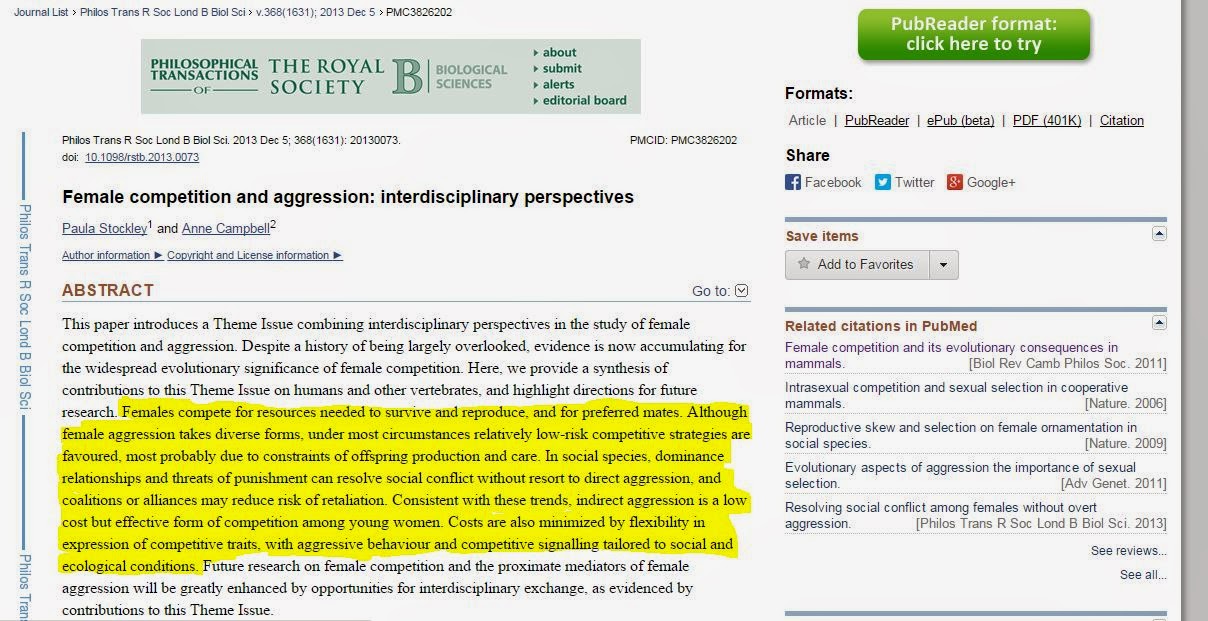

And in yet another biological study from an evolutionary standpoint, it finds that women use indirect aggression against competitors for preferred mates, thus further telling us that women have always been the selectors of men and judges of other females, specially rivals:


Source: http://www.ncbi.nlm.nih.gov/pmc/articles/PMC3826202/


And when it comes to the socialist feminists' claims that not only patriarchy but capitalism also oppresses women, but we have already debunked that idea many times in this blog considering women out earn men when met in the same conditions (single and childless), hold over half the wealth in the U.S, are majority of voters and are over 60% of college graduates in our capitalist society.

And the claims of post-modern feminists claims about social deviance (women are not as aggressive as men) is due because that's how patriarchy has brainwashed women to behave (nurturing and passive or passive-aggressive), hence why women don't deviate from their socially imposed norms. This very laughable "social construct" myth being already debunked by the previous studies cited in this post clearly defining women as less competitive and aggressive compared to men when it comes to biological and evolutionary empirical evidence. 

Any excuses feminists make for deliberate or biologically induced female behavior, we can definitely see that women do have agency and dominant traits attributed to their gender. Their buzzwords like "Patriarchy" or "Social Construct", carry no weight when exposed to the light of facts.


Saturday, May 2, 2015

Despite Women and Girls having Most Federal Grants, The University of Washington Offers Female Students Hand Outs to Join STEM.

Despite the feminist movement claiming that life in campus is a rapist paradise and women are discriminated against in the STEM fields (which both are thoroughly debunked in our previous posts), the University of Washington in Seattle is offering rent-free, paid groceries, a MacBook in 8 bedroom housing for women only in order to entice girls to join sciences:
"If you’re a woman studying computer science at the University of Washington and need a place to live — for free — there’s a new option on the market for you.As a way to promote the advancement of women in technology, Seattle mobile marketing analytics startup Tune is hosting an 8-bedroom house near the UW campus called Tune House that offers a place to live for women pursuing a degree in computer science and/or information technology.Tune, which is renting the house, will cover housing costs, weekly groceries, and provide a MacBook to each student for the entire school year starting on Sept. 20 of this year through June 30, 2016."


http://www.geekwire.com/2015/seattle-startup-tune-opens-an-8-bedroom-house-with-free-rent-for-women-studying-computer-science/?utm_source=GeekWire+Daily+Digest&utm_campaign=60b81d9c9b-daily-digest-email&utm_medium=email&utm_term=0_4e93fc7dfd-60b81d9c9b-233567481&mc_cid=60b81d9c9b&mc_eid=9415e0f170

All this effort to openly discriminate against boys and highly favor girls; boys, who only have one federal program called "My Brother's Keeper", which the feminist movement also hijacked by pressuring the government to include girls into it, despite they already having most of the programs and grants veered towards their gender only:

The Heart Truth
National Women’s Health Week
National Women and Girls HIV/AIDS Awareness Day
National Community Centers of Excellence in Women’s Health
HIV Prevention Programs for Women
Office on Women’s Health at CDC
African American Women and Mass Media (AAMM) Campaign
The WISEWOMAN program
The Office of Research on Women’s Health
Advancing Novel Science in Women’s Health Research (ANSWHR) Exploratory/Developmental Research Grants
Specialized Centers of Research on Sex and Gender Factors Affecting Women’s Health
Building Interdisciplinary Research Careers in Women’s Health
US Food and Drug Administration Office of Women’s Health (FDA)
Women-Owned Small Businesses (U.S Small Business Association)
US Food and Drug Administration – For Women FDA
Targeting Obesity in Young Women to Prevent the Development of Type II Diabetes (Federal Grant Program)
HRSA Office of Women’s Health (U.S Department of Health and Human Services)
Women and Girls Initiative (Environmental Protection Agency)
Women Outreach Program (U.S Department of Agriculture)
Girl’s Health
Center for Women Veterans
Women Veterans Health Care
Women Veterans Program Minnesota
Women Veterans Program Massachusetts
White House Council for Women and Girls
White House Interagency Council on Women and Girls
Women’s Educational Equity Act
EVEN START DISCRETIONARY GRANT TO PRISONS THAT HOUSE WOMEN AND CHILDREN
NASA Aspire to Inspire
NASA SISTER Program
Clean Energy
 Education and Empowerment “C-3E” Women’s Initiative (Department of Energy)

ADVANCE: Increasing the Participation and Advancement of Women in Academic Science and Engineering Careers (National Science Foundation)
Administration on Aging (AoA) National Education and Resource Center on Women and Retirement Planning (US Department of Health and Human Services)
U.S Department of Labor Women’s Bureau
Women in Apprenticeship and Nontraditional Occupations Act (WANTO)
Green Jobs for Women
Office on Violence Against Women
Violence Against Women Grant Programs
Enhanced Training and Services to End Violence and Abuse of Women Later in Life
Education, Training and Enhanced Services to End Violence Against and Abuse of Women with Disabilities Grant Program
NYC Women’s Health
Illinois Women’s Healthcare Portal
Women, Infants and Children(WIC)
Free Women’s Self Defense Program Virginia
Women’s Way North Dakota
Office of Women’s Health Arizona
USAID Women’s Empowerment


Thursday, April 30, 2015

The Pink Tax Myth: Women Prefer to Pay More In Order to Flaunt Social Status and Sexual Value.

        Now that the ludicrous claim by feminists that there is a discriminatory gender wage gap has been  debunked,  they are claiming now that women suffer heavier taxes than men for the "exact same services and products". We can read such a claim right here by feminist Elizabeth Plank:


"Thought the wage gap was the biggest strain on your lady wallet? There's another reason being a woman drains your bank account, and it's got nothing to do with the fact that we make 77 cents to the dollar.

It's called the pink tax, and if you're a woman whose daily priorities include a moderate amount of grooming and personal hygiene, over the course of your lifetime it could cost you roughly $100,000...
Companies also charge more because they know that female consumers will buy these products, due in no small part to savvy marketing teaching consumers that certain products are just for women or men, but not both. As a result, women may not consider purchasing a product targeted towards men as an option, even if it costs less."

It's called the pink tax, and if you're a woman whose daily priorities include a moderate amount of grooming and personal hygiene, over the course of your lifetime it could cost you roughly $100,000...

Companies also charge more because they know that female consumers will buy these products, due in no small part to savvy marketing teaching consumers that certain products are just for women or men, but not both. As a result, women may not consider purchasing a product targeted towards men as an option, even if it costs less."


But with some investigation, we actually find out that women are not getting ripped off as feminists would like us to believe, but the fact of the matter is, female products and services are more complex than men's:


"They may do the same job and be made of the same materials. But the fact that a man’s shirt is a called, well, a shirt, and the woman’s version a blouse, will hit you straight in the pocket. 
According to a study published in the journal Gender Issues, dry-cleaning women’s shirts costs twice as much as men’s, on average.It means that if a male and female had one set of collars and cuffs dry-cleaned every month for ten years, it would cost a man £162, while a woman would fork out around £310. 
A study has shown that the dry-cleaning costs of women's shirts is twice as much as men's shirts, on average (picture posed by model)However, Martyn Lewis of the Textile Services Association, which represents dry-cleaners, claims there are good reasons for the price divide. He says: ‘It’s not that we see women customers coming and think, “Right, we’ll charge you a fiver more”.‘The reason is that the man’s garment comes in a standard shape so it can be placed on the shirt-finishing machine (a dummy onto which a shirt is fitted during pressing).‘A lady’s blouse is more shaped — for obvious reasons — and therefore it needs ironing by hand.‘We charge according to the garment, not the customer.’ 
EVEN RAZORS ARE MORE EXPENSIVE 
Beware pink packaging when you’re shopping for personal-care products. It’s often a sign there’ll be a higher price tag.For example, one razor in a four-pack of Gillette Simply Venus 2 disposables for women cost 56p each — 13 pence more than those in the ten-pack of the male version, Gillette Blue II, on boots.com.Gillette spokesman James Williams claims the price difference is there for a reason: men’s and women’s razors have different blades, heads and pivots to perform separate jobs. 
One razor in a four-pack of Gillette Simply Venus 2 disposables for women costs 56p — 13 pence more than those in the ten-pack of the male version, Gillette Blue II‘The hair women are shaving on their bodies — legs, underarms, bikini line — is very different to those men shave on their face and neck; they are different lengths and have different coarseness and density. 
‘Women are also typically shaving a much larger area than men and nearly every body part she shaves has curvature — either convex or concave — like the front and back of knees, ankles, back of the legs, bikini line and underarm, and is often more difficult to reach.’


PERFUME’S A PAIN ON THE PURSE 
Do you always like to smell your best? If so, you’ll be forking out more cash than a man for that, too.A 50ml bottle of Jean Paul Gaultier Eau de Toilette spray for women, which comes in a curvy bottle, will set you back £49 at Tesco. A 75ml bottle of Jean Paul Gaultier Eau de Toilette for men, in the shape of a manly torso, is priced considerably less at £38. Per 100ml, that works out as almost twice as expensive. 
Perfume expert Peter Sherlock told the Mail: ‘The reason perfumes for women cost more is due to the cost of extracting the scent from flowers.
A 50ml bottle of Jean Paul Gaultier Eau de Toilette for women costs £49 at Tesco. A 75ml bottle of Jean Paul Gaultier Eau de Toilette for men is considerably less at just £38 
‘On the whole, female fragrances contain a much bigger concentration of floral notes, for example the jasmine and rose in Chanel No. 5 —and so they cost more to make. Men’s fragrances tend to be more wood or citrus based and these are substantially cheaper ingredients.’ 
There is also the fact that famous females are more likely to be used to sell scent for women — considerably boosting the marketing spend, says retail analyst Chris Field, who adds that women customers are also more likely to pay for products which they view as ‘reassuringly expensive’.


GARAGES DRIVE A HARDER BARGAIN 
The moment a woman steps onto a garage forecourt, mechanics seem to get pound signs in their eyes.According to one study, a repair job that costs a man about £180 will cost a woman £200. 
Susan Abbs, one of the UK’s few female garage-owners, says: ‘Women pay more because the moment they step into a repair garage they are in a male-dominated environment and out of their comfort zone. 
Susan Abbs, one of the UK’s few female garage-owners, says women are in a male-dominated environment at a garage and therefore out of their comfort zone, leading them to be charged more (picture posed by models)‘If a woman calls a plumber out, he’s coming into her space. In a garage, she is right in the middle of the lion’s den. 
‘Few women — and actually, few men — understand how a car works. But a woman is less likely to ask questions for fear of sounding silly.‘They also rely on their cars more for school runs, ferrying children about and getting to work. Therefore they are often more anxious to get the problem sorted — whatever it costs.’ 
Susan, who set up the Pullman Garage in South London over 30 years ago, says male staff at the bigger car repair chains tend to work on commission. ‘So if they make a woman insecure and worried enough to have all four tyres replaced instead of the two that really need doing, they are more likely to hit targets,’ she says.


HIGHER COST OF HAIRCUTS 
You may have a gamine pixie style shorter than your husband’s. Yet hairdressers will still charge you considerably more for a cut, just because you’re female.At national salon chain Toni & Guy, for example, men’s hair services are £10 less across the board. 
At HOB salons, the price gap is even wider. A cut and finish is £50 for female customers, £18 more than the male price.
Retail expert Nick Swan, founder of vouchercodespro.co.uk says women are willing to pay more for ‘necessary luxuries’. 
‘Men see a haircut as a more of a chore and only get it because they need to and are not willing to pay too much,’ he says. ‘There’s also the fact many women don’t trust cheap haircuts and stick with the salon they know do a good job.‘It means that salons can charge over the odds because they know their female clients will keep coming back.’ 
To get some gender equality for your hair, look for a salon that charges by the hour, not by what sex you are. Lucy Cogan, celebrity hair stylist, of the Chapel, North London, says times are changing as men become more image conscious.‘These days, it can take as much time to do gents’ as women’s hair because modern men want more intricate and stylish haircuts,’ she explains. ‘It’s no longer just a short back and sides so an hourly rate is much fairer.’


BEWARE PRETTY PACKAGING 
One may come looking macho in a silver or black can and the other may be decorated with girly flowers and swirly patterns — but there’s likely to be little difference between your partner’s deodorant and yours as far as the active ingredients are concerned. 
That’s not always reflected in the price, however.One expert study by the University of Florida in the U.S. found that on average a woman’s anti-perspirant costs around 15p per ounce more than a man’s — and the only difference is the scent. 
As an example of this, Nivea Stress Protect Anti-Perspirant Deodorant — which comes in a feminine white and blue can — costs £1.43 per 100ml. The man’s version of Nivea Stress Protect — in a manly black and blue can — costs £1.32 per 100ml, both on boots.com. Simonne Gnessen, co-author of Sheconomics, points out, however, that women enjoy paying more for some products. She says: ‘A woman’s sense of self is more closely tied to shopping. We associate high price with quality. It’s the “because I am worth it” effect. 
‘The marketeers have discovered they can get away with charging more for some female products because women actually feel better about paying more.’


OVERPAYING FOR UNDERWEAR 
If you compare briefs for a man and woman, there’s not much difference in price for everyday underwear. But when you consider the amount charged for bras, it quickly becomes clear how expensive it is to be female. 
Considering that the average British woman has six bras she wears regularly, and most are priced between £16 to £30 at the nation’s biggest underwear seller, Marks & Spencer, that works out at a cost of £138 year. This adds up to a lifetime total of nearly £10,000 from puberty and the first trainer bras, to the end of a woman’s life.Indeed, according to Office for National Statistics data, women spend twice as much as men on underwear every year because they also have to buy tights.And coming in at around £10 a pair, tights are more expensive than socks — and need to be replaced more owing to the fact they ladder more easily.


THE PRICE OF PROTECTION 
This is one cost a man never has to deal with.

Sanitary protection is not something that men will ever have to buy for themselves, but it is estimated that women will spend around £1,430 on sanitary products in their lifetime 
Considering that a woman will have up to 500 periods over a lifetime, it’s also an outgoing that can really stack up. According to industry estimates, most women will need at least 11,000 separate items of sanitary protection during her fertile years.As sanitary towels and tampons both cost an average of 13p each, this adds up to an outlay of £1,430 between the start of her periods and the onset of the menopause."

Source:  http://www.dailymail.co.uk/femail/article-2959383/Why-expensive-woman-called-pink-tax-women-pay-men-dry-cleaning-razors.html#ixzz3YqRRaqYh


         Now that we got the fact how women's services and products can be easily explained because of the marketing and how more detailed they are, and not due to sexism, let's investigate what psychologists say about women liking expensive products.
 By reading two studies on market factors on women, we can see how women correlate more expensive products with higher sexual value, social status, partner's social status; which they use to signal to other women to back off:


Source: http://pss.sagepub.com/content/early/2013/11/22/0956797613502732.abstract


Source: http://web.natur.cuni.cz/~houdek3/papers/Wang%20et%20al%202014.pdf

Also, women tend to pay more for other services like health care for the fact they tend to use it more than men, but men pay more for auto insurance despite women getting in more car accidents in higher rates, because men tend to get into more fatal accidents. Time Business reports on those findings:


"The main explanation given for the health insurance gender discrepancy is a simple one: Women tend to use health care services a lot more than men. For a variety of reasons, women are more likely to go the doctor—or even have a doctor—than men, and insurance companies say they should pay for the privilege. Is this justification enough to charge exorbitantly higher premiums to women? It is from the insurance company’s perspective. Speaking of which … 
Men pay more for auto insurance. 
A CBS News post cites a new study from the insurance-shopping site CoverHound indicating that, on average, men pay roughly $15,000 over their lifetimes for car insurance. Again, some extreme extremes are highlighted: 
For instance, an 18-year-old male living in Nevada would pay an average of $6,268 a year to insure his sedan if he had the misfortune to grow up there. That’s 51% higher than what his twin sister would pay (assuming they have the same grades and driving records), who would fork out just $4,152 to insure an identical car, according to a CoverHound analysis.

This is all assuming that neither 18-year-old was incorporated in his or her family’s insurance policy, which is a much more cost-effective option than going it alone. In any event, insurance companies justify higher rates for young men because the numbers (and the assumptions) say that guys drive more aggressively and get into more accidents than young women.

There are exceptions to the 'guys pay more' rule: In a few states, women in the 35- to 50-year-old demographic—who are more likely to have kids distracting them in the car—pay higher car insurance premiums than men of the same age. 
As an AOL News story from last fall points out, many of the justifications for charging men more for auto insurance are based on outdated stereotypes. Men have historically gotten into more accidents than women at least partly because they drive more—about 60% of all miles driven in the U.S. But the driving gap is closing: Women account for roughly half of all American drivers today, up from 43% in the 1960s. And yet, even as the numbers show, women are more likely to get into car accidents, there seems to be one big reason why men must pay more: 
According to a study by the Johns Hopkins School of Public Health, women were involved in more 5.7 crashes per million miles driven, while male drivers had 5.1 crashes over the same distance. But even though they get into fewer crashes, the Johns Hopkins study said men are three times more likely to die in a car crash. 

So we can finally put to rest yet another ridiculous feminist myth, that despite being thoroughly debunked, will probably be spewed frequently by the media, White House and academics- just like their beloved gender wage gap- but we'll be here challenging their claims.