Revealing the systematic demonization of the male gender. Examining how our culture is steeped in radical feminism, and how we got to where we are today.
Monday, April 6, 2015
A Study from Washington State University reports: White men more than likely to be shot by police than women.
Here's more of your so-called white/male privilege feminists keep telling us about; a scientific study from Washington State University-Spokane, quietly reported that women are way less likely to get shot by police than men, amidst racial controversies on which ethnicity are more likely to get shot by the police:
“Across these 300 interviews, I have multiple officers telling me that they didn’t shoot only because the suspect was black or the suspect was a woman, or something that would not be consistent with this narrative of cops out there running and gunning,” said Mr. Klinger, a former cop and author of “Into the Kill Zone: A Cop’s Eye View of Deadly Force” (2006).
Sunday, April 5, 2015
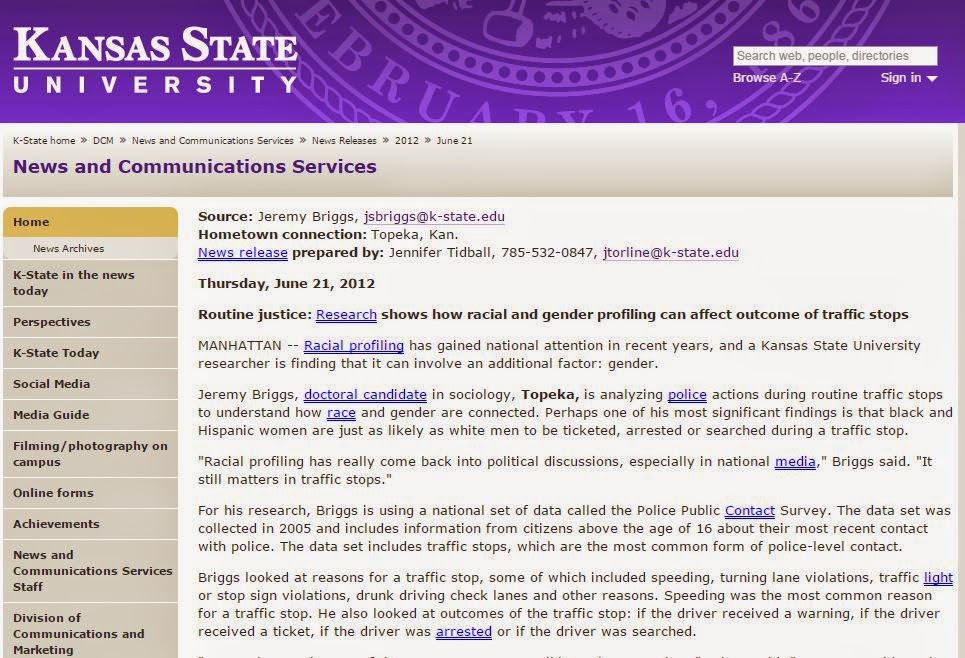
Routine justice: Research shows how racial and gender profiling can affect outcome of traffic stops
One of the feminist movement's most used sound bites, is the term "white privilege"; which implies that white people benefit from society at large solely by being white. But the usual connotation they imply with "white privilege" is "white male privilege", considering patriarchy theory proposing that white men are in power and created their social benefits.
Now this is another feminist myth put to rest. Jeremy Briggs, a doctoral candidate of sociology from Kansas University, put together an extensive research on how police officers profile people; and the findings indicate that women highly benefit from social privilege; and white women are more likely than women from minority backgrounds, from hardly to receive punishment to no punishment or profiling at all:
MANHATTAN -- Racial profiling has gained national attention in recent years, and a Kansas State University researcher is finding that it can involve an additional factor: gender.
Jeremy Briggs, doctoral candidate in sociology, Topeka, is analyzing police actions during routine traffic stops to understand how race and gender are connected. Perhaps one of his most significant findings is that black and Hispanic women are just as likely as white men to be ticketed, arrested or searched during a traffic stop.
"Racial profiling has really come back into political discussions, especially in national media," Briggs said. "It still matters in traffic stops."
For his research, Briggs is using a national set of data called the Police Public Contact Survey. The data set was collected in 2005 and includes information from citizens above the age of 16 about their most recent contact with police. The data set includes traffic stops, which are the most common form of police-level contact.
Briggs looked at reasons for a traffic stop, some of which included speeding, turning lane violations, traffic lightor stop sign violations, drunk driving check lanes and other reasons. Speeding was the most common reason for a traffic stop. He also looked at outcomes of the traffic stop: if the driver received a warning, if the driver received a ticket, if the driver was arrested or if the driver was searched.
"In a real scenario, any of those outcomes are possible at the same time," Briggs said. "A person could receive a ticket and be arrested. Or they could be searched but just receive a warning. There are a number of possibilities in any given stop."
From 23 possible outcome variables in the data, Briggs constructed a dependent variable that consisted of four mutually exclusive traffic stop outcomes. He used multinomial statistical techniques to estimate the strongest predictors of each of these outcomes.
Some of his most significant findings include:
* When compared with men, women were 23 percent less likely to be ticketed, 55 percent less likely to be arrested and 76 percent less likely to be searched when stopped by police. Women were more likely to only receive a warning or have no outcome when stopped by police during a traffic stop.
* Black and Hispanic drivers were significantly more likely to be searched, ticketed and arrested than white drivers when stopped by police. For example, black drivers were more than twice as likely to be searched or arrested when compared with white drivers. Hispanic drivers were almost three times as likely to be searched when compared with white drivers.
By combining data dealing with race and gender, Briggs found the differences between men and women do not hold up for all races. Out of all racial and ethnic categories of male and female drivers, white women were most likely to receive a perceived benefit in a traffic stop, such as receiving only a warning or no outcome at all. But the same is not true for black and Hispanic women, who were just as likely as white men to be ticketed, arrested or searched instead of receiving a warning or no outcome.
Black and Hispanic men were the most likely to be ticketed, arrested or searched during a traffic stop. Black men were 2.5 times as likely as white men to be arrested and twice as likely to be searched. Hispanic men were 1.5 times as likely as white men to receive a ticket and more than three times as likely to be searched.
"We can't make sense of racial differences without also considering sex and gender," Briggs said. "We have to look at sex and gender at the same time as race and ethnicity because they're connected in important ways. What I found in the case of traffic stops was that racial differences are deeply gendered as well. This connection should be a part of the larger racial profiling discussion."
Briggs also studied the race of police officers during traffic stops. He found that officer race does not appear to have a significant effect on the outcome of the traffic stop. Rather, the outcome seemed to be most affected by driver's characteristics.
"It is possible that racial and gender differences are explained by some of the controls, such as the reason for the stop, driving frequency and other demographics," Briggs said. "But it's also possible that when considering all these other controls, racial profiling still stands. My analysis shows that race and gender do still matter in traffic stops, even controlling for many of these other factors."
Briggs plans future studies that will focus on different types of analysis with race and sex categories. His adviser is Dana Britton, professor of sociology.
Friday, April 3, 2015
More Feminist Lies Debunked: 26%,not 65% of Brazilians Believe Women Who Dress Scantily Deserve to be Raped. (12.8% of those 26% partially believe),
The feminist movement last year was crying at the top of their lungs claiming that 65% of the people in Brazil believed that women who were dressed scantily deserved to be raped. You can see feminists making the claim in the screenshot and at the link below:
That statistic has now been revealed to be false by the researchers themselves who the statistic is supposedly derived from. The Washington Post is one of the few media outlets that admitted their mistake once the researchers corrected them in their article. Quote:
"The correct figure for the percentage of Brazilians surveyed who agreed that women who dress in a revealing way “deserve to be attacked” was actually 26% they said – not 65%. And then there’s this: More than two-thirds of the respondents were women."
And in a Google translated Brazilian mainstream media coverage of the correct report, it further states that out of those 26%, 13.2% totally agree with the "deserve to be attacked" and 12.8% say the partially agree:
"Women who wear clothes that show the body deserve to be attacked (in%):
13.2% totally agree
12.8% partially agree
3.4% are neutral
58.4% strongly disagree
11.6% partially disagree"
Thursday, April 2, 2015
Feminist Jessica Valenti's Great Disservice to Mothers and Children.
Jessica Valenti, the Guardian's feminist writer, has once again endeavored in doing mothers and children a disservice by lying about the benefits of breast milk implying that the science behind the health benefits is shoddy and inconclusive because studies do not count contrasts between lower and higher class, and white and minority mothers; plus the availability of time to breastfeed their children. As always, middle class and wealthy white feminists pulling the race card and using black women as mascots and shields; here are some quotes from her article:
"But breast milk being turned into a commodity rather than a freely shared favor has raised some hackles: what does it mean if low income women would rather pump to sell than breastfeed their own children? Are companies already targeting poor women and women of color?
No matter the ethical implications, selling breast milk is the inevitable result of telling women they’re creating “liquid gold” with every pump. So stopping the commercialization of breast milk would mean owning up to a very unpopular truth: the benefits of breastfeeding are murky at best.
Most major studies that have been done on breastfeeding conflate correlation with causation. Yes, breastfed babies are more likely to be healthy than formula-fed children – but we don’t know why that is. As professor Joan Wolf, author of Is Breast Best?, told the Guardian in 2013, “Women who choose to go through the labour of breastfeeding have made a commitment to go the extra mile for the sake of their baby’s health”.
Moms who have the time to pump for hours a day, for example, likely have more time to play and read to their children.Women whose employers provide lactation rooms and breaks are more likely to have jobs with better pay and benefits. It’s difficult to distinguish the benefits of having a more privileged or involved parent from the benefits of breastfeeding.
Even in the most recent large-scale study on breastfeeding, researchers admitted that the role mothers play in overall development could have impacted their results. (The one proven perk of breast milk is that it helps to promotegastrointestinal health – a small benefit for healthy babies, but a tremendous one for preemies who are at risk for the deadly intestinal infection, necrotizing enterocolitis.)
Despite the shaky science, we largely accept that breastfeeding isn’t just a better choice, but the only choice if you care about your kids. When New York City launched a breastfeeding initiative, for example, participating hospitals were instructed to treat formula like prescription medicine: moms who wanted formula would have to listen to a mandatory talk on the benefits of breastfeeding and give a “medical” reason for why they wanted formula. So much for my body, my choice!"
But a recent study from Brazil, also reported on by the Guardian's Sarah Boseley (Health Editor), which covers a range of 30 years of research on breastfeeding, accounted for all the variables Valenti had a problem with in demographic variables, causation for benefits(which she claimed there was no consensus what nutrients causes benefits) and her claim that the benefits are exaggerated. This study provided concrete proof that breastfeeding also impacts overall intelligence and success in life:
"The longer babies breastfeed, the more they achieve in life – major studyBrazilian study of 6,000 babies from all backgrounds since 1982 finds those who breastfed were more intelligent, spent longer in education and earned more."
Researchers in Brazil have followed nearly 6,000 babies from birth for the past three decades, enabling them for the first time to get an idea of the long-term effects of breastfeeding. Nearly 3,500 of them, now 30-year-old adults, accepted an invitation to be interviewed and sit IQ tests for the purpose of the study. Those who had been breastfed proved to be more intelligent, had spent longer at school and earned more than those who had not been. And the longer they were breastfed as a baby, the better they tended to be doing.
It is already known that breastfeeding can increase a child’s IQ by a small amount. The question that Dr Bernardo Lessa Horta from the Federal University of Pelotas in Brazil wanted to answer was whether this translated into greater intelligence and better prospects as an adult.
'Our study provides the first evidence that prolonged breastfeeding not only increases intelligence until at least the age of 30 years but also has an impact both at an individual and societal level by improving educational attainment and earning ability,' he said.
It is not just the age of the participants that makes this study unusual. Horta says it is free of the major complication of most breastfeeding studies because, when it began in 1982, it was not just the more affluent and educated mothers who breastfed in Brazil. Breastfeeding was not limited to one socio-economic group. It was, he says, evenly distributed across the social classes. So the higher achievers at the age of 30 did not come from better-off homes.
Nonetheless, in analysing their results, now published in the Lancet Global Health journal , they took account of family income at birth, parental schooling, genomic ancestry, maternal smoking during pregnancy, maternal age, birthweight and type of delivery to try to avoid any of those factors skewing the results.
They found that all the breastfed babies had greater intelligence, as measured by a standard IQ test, had spent more years in education and had higher earnings. But the longer they had been breastfed, the greater the benefits. Children who had been breastfed for 12 months had an IQ that was four points higher than those breastfed for less than a month, had nearly a year’s more schooling and earned around £70 a month more – about a third more than the average income level.
Horta acknowledged he could not completely rule out the possibility mothers who breastfed helped their babies’ development in other ways. 'Some people say it is not the effect of breastfeeding but it is the mothers who breastfeed who are different in their motivation or their ability to stimulate the kids,' he told the Guardian.
But, he said, there is evidence from other studies of the nutritional value of mother’s milk, rich in long-chain polyunsaturated fatty acids that are essential for brain growth. Some studies have suggested babies with a particular genotype are more likely to get the IQ benefit from breastfeeding than others. Horta and colleagues are now looking to see whether that applies in their cohort.
Exclusive breastfeeding for the first six months is recommended by the World Health Organisation. Horta said babies who had been breastfed for six months got most of the benefits enjoyed by those who were fed for longer. 'Mothers should breastfeed for as long as possible,' he said, but he recognised that extended breastfeeding is not always easy for women. Less than a quarter of new mothers in the UK are still exclusively breastfeeding by the time the baby is six weeks old.
Dr Colin Michie, chair of the Royal College of Paediatrics and Child Health’s nutrition committee, said: “It’s widely known that breastfed babies are better protected against chest and ear infections, are at less risk of sudden infant death and are less likely to become obese, but it’s interesting to see the benefits of breastfeeding for a prolonged period of time not only benefit the baby in the early years, but also translate into increased intelligence and improved earning ability later in life.
'It is important to note that breastfeeding is one of many factors that can contribute to a child’s outcomes, however, this study emphasises the need for continued and enhanced breastfeeding promotion so expectant mothers are aware of the benefits of breastfeeding. Furthermore, once mothers have given birth, we must ensure they are properly supported to continue breastfeeding for as long as they are able to.'"
- And when investigation why women in the US do not choose to initiate breasfeeding, you have a barrage of lame excuses and lack of initiative and curiosity for it as reported by Womens Health Issues. 2009 Jul–Aug; 19(4): 268–278
"In 2005, estimates for initiating breastfeeding and continuing to 6 months of age in the United States were 72.9% and 39.1%, respectively (Centers for Disease Control and Prevention [CDC], 2007). Twenty-one states achieved the first Healthy People 2010 objective of 75% of mothers initiating breastfeeding (CDC, 2007). Several states, especially Southern states (Alabama, Arkansas, Mississippi, South Carolina, and West Virginia) have low breastfeeding initiation rates, ranging from 48% to 59%. Racial and ethnic disparities also exist in breastfeeding initiation rates. In 2005, the rate of ever breastfeeding was 79.0% among Hispanics, 74.1% among non-Hispanic Whites, and 55.4% among non-Hispanic Blacks (CDC, 2007).Using four years of data from Arkansas, we found that 37.7% of women chose not to initiate breastfeeding. Addressing our first research question, reasons women provide for not initiating breastfeeding, we found that the most frequent reasons women identified were individual reasons, such as not wanting to be tied down, not liking breastfeeding, being embarrassed, and wanting the body back to oneself. The next most frequent reason was household responsibilities, such as having other children to care for, followed by circumstances such as going back to work or school. These findings are consistent with those of previous studies (Ahluwalia et al., 2005; Guttman & Zimmerman, 2000).
Jessica Valenti and her movement need to be cited these studies to show them how much damage they are doing doing by teaching women to be selfish in their responsibilities when they demand fathers to be responsible first, before having access to their flesh and blood. This is a another prime example of moral hypocrisy and double standards from the feminists.
Brazilian Feminists Lie About the Numbers of Sexually Assaulted Young Girls.
The "Vadias" or Sluts, which are part of the slutwalkers part of the feminist movement in Brazil, made a bold claim that 30% of girls suffer sexual assault before they reach the age of 18. They still spewing this garbage in Brazil despite this claim being discredited. Here are the official numbers from the Brazilian Government :
"Preliminary data show that sexual violence also ranks second in the age group 10-14 years, 10.5% of notifications, second only to physical violence (13.3%). In the range of 15 to 19 years, this type of aggression is in third place with 5.2%, behind the physical violence (28.3%) and psychological (7.6%). The data also show that 22% of total records (3,253) involved children under 1 year and 77% were in the age group 1-9 years. The percentage is higher in male children (17%) than females (11%).
Most of the attacks occurred in the residence of the child (64.5%). Regarding the medium used to assault, physical force and beating was more pointed means (22,2%), reaching more boys (23%) than females (21.6%). In 45.6% of cases the likely author of violence were male."
So we can see that not only are the numbers highly exaggerated by the feminists, but boys are actually the higher percentage of sexually assaulted victims and men only comprise 45.6% percent of assailants.
Quote: " 30% of girls suffer from sexual violence before age 18."
2013 Report by the US Department of Justice Reports: Female prison officers commit 90% of sex assaults on male teens in US juvenile detention centres.
We hear plenty in the news and in everyday discussions about the male sexual offender and how prevalent they are and awareness of male sex offenders is great as long as it doesn't descend into paranoia.
However we rarely hear about female sex offenders and the professions they tend to go into. This latest article from International Business Times shows that female prison guards commit 90% of the sexual assaults on boys in detention centers and female offenders could be drawn to these jobs for this very reason. Quote:
"A recent lawsuit in Idaho involving five teenage victims of sexual abuse at a state juvenile detention centre highlights the prevalence of sexual victimization of juvenile offenders.
The suit, which was filed in state District Court in Boise on 19 March, alleges that five boys were sexually abused by several female employees. One of the victims, a 16-year-old boy, was reportedly given street drugs by a nurse and forced to have sex with her and a student intern...
Unfortunately, the circumstances in the Idaho case are not that uncommon.
A 2013 report by the US Department of Justice on the sexual victimization of youths in juvenile facilities revealed that 89.1% of young prisoners claiming victimization were males reporting sexual activity with female staff."
However we rarely hear about female sex offenders and the professions they tend to go into. This latest article from International Business Times shows that female prison guards commit 90% of the sexual assaults on boys in detention centers and female offenders could be drawn to these jobs for this very reason. Quote:
"A recent lawsuit in Idaho involving five teenage victims of sexual abuse at a state juvenile detention centre highlights the prevalence of sexual victimization of juvenile offenders.
The suit, which was filed in state District Court in Boise on 19 March, alleges that five boys were sexually abused by several female employees. One of the victims, a 16-year-old boy, was reportedly given street drugs by a nurse and forced to have sex with her and a student intern...
Unfortunately, the circumstances in the Idaho case are not that uncommon.
A 2013 report by the US Department of Justice on the sexual victimization of youths in juvenile facilities revealed that 89.1% of young prisoners claiming victimization were males reporting sexual activity with female staff."
The Medical Industry and Mainstream Media's False Numbers on Heart Disease Deaths by Gender.
A recent study reported by Pacific Standard Magazine, suggests that younger women are dying at higher rates than young men of heart diseases such as coronary heart disease, the most common cause of heart attacks, and when women do have heart attacks, they tend to die twice as more as young men:
"Heart disease is the number one killer of both men and women in the United States, yet it’s long been considered a “man’s disease” in the popular imagination. This perception likely stems, in part, from the fact that coronary heart disease, the most common cause of heart attacks, is more prevalent among men—and tends to strike them at a younger age. When younger women do have heart attacks, though,studies have found that they are about twice as likely to die as their male counterparts—and more than 15,000 women under the age of 55 do every year."
But the study did admit that the data is conflicting in their abstract:
"There is conflicting information about whether short-term mortality after myocardial infarction is higher among women than among men after adjustment for age and other prognostic factors. We hypothesized that younger, but not older, women have higher mortality rates during hospitalization than their male peers."
"We analyzed data on 384,878 patients (155,565 women and 229,313 men) who were 30 to 89 years of age and who had been enrolled in the National Registry of Myocardial Infarction 2 between June 1994 and January 1998. Patients who had been transferred from or to other hospitals were excluded."
"The overall mortality rate during hospitalization was 16.7 percent among the women and 11.5 percent among the men. Sex-based differences in the rates varied according to age."
After myocardial infarction, younger women, but not older women, have higher rates of death during hospitalization than men of the same age. The younger the age of the patients, the higher the risk of death among women relative to men. Younger women with myocardial infarction represent a high-risk group deserving of special study
"Heart disease is the number one killer of both men and women in the United States, yet it’s long been considered a “man’s disease” in the popular imagination. This perception likely stems, in part, from the fact that coronary heart disease, the most common cause of heart attacks, is more prevalent among men—and tends to strike them at a younger age. When younger women do have heart attacks, though,studies have found that they are about twice as likely to die as their male counterparts—and more than 15,000 women under the age of 55 do every year."
But the study did admit that the data is conflicting in their abstract:
METHODS:
RESULTS:
CONCLUSIONS:
Now what needs to be further disclosed is that this study investigated from ages 30 to 89 years of age of both genders and the article from PSmagazine mentions only women below 55 are twice as more than men of the same age range to die of heart diseases. Now let's investigate if both claims are true when we investigate the CDC's numbers of causes of deaths by gender and age:
Male heart disease deaths 321,347 percent 24.6 rate 206.5 pg 12
Female heart disease deaths 289,758 percent 22.4 rate 180.6 pg 23
Now let's investigate below ages 55 for the genders
Male ages 25-29 heart diseases deaths 775, percent 5.2, rate 7.1
Male ages 30-34 heart diseases deaths 1,439, percent 8.8, rate 13.5
Female ages 25-29 heart diseases deaths 380 percent 6.3 rate 3.6
Female ages 30-34 heart diseases deaths 664, percent 8.3, rate 6.3
We can read the rest until we reach below 55 and you'll see in the pdf that the numbers, percentages and rates of heart disease deaths are even on greater gaps for men having higher numbers in all. Once again, the media and medical industry have done a fine job of using conflicting hypothesized numbers and sold us the lie that younger women die of heart diseases more than men in the same age range.
Subscribe to:
Posts (Atom)